This manual serves as a comprehensive guide, detailing essential techniques and reactions explored within the organic chemistry laboratory setting. It’s designed to enhance practical skills and understanding.
Purpose and Scope
The primary purpose of this organic chemistry laboratory manual is to provide students with a foundational understanding of experimental techniques crucial for success in organic chemistry. This manual aims to bridge the gap between theoretical concepts and practical application, fostering critical thinking and problem-solving skills.
The scope encompasses a range of core techniques, including recrystallization, distillation, extraction, and chromatography, alongside fundamental spectroscopic methods like IR spectroscopy. Furthermore, it details common organic reactions – alkene synthesis, SN1/SN2 reactions, esterification, aldol condensation, and oxidation – through detailed experimental procedures.
This manual isn’t merely a collection of procedures; it emphasizes safety protocols, data analysis, and proper lab notebook documentation. It prepares students for advanced techniques and responsible handling of chemical substances, including air-sensitive reagents and waste disposal, ultimately cultivating competent and conscientious chemists.
Safety Regulations and Procedures
Prioritizing safety is paramount in the organic chemistry laboratory. This section outlines essential regulations and procedures to minimize risks and ensure a secure learning environment. Strict adherence to these guidelines is mandatory for all students and personnel.
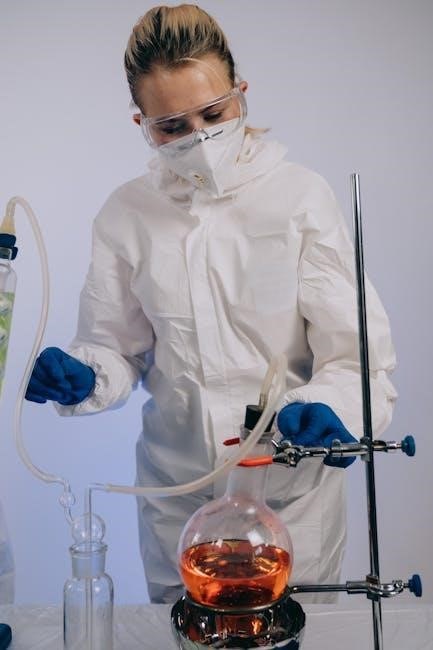
Key regulations include mandatory eye protection (safety goggles at all times), appropriate attire (no open-toed shoes, long pants), and proper handling of chemicals. Familiarize yourself with the location and use of safety equipment – fire extinguishers, eyewash stations, and safety showers.
Detailed procedures cover chemical waste disposal protocols, spill management, and emergency contact information. Never work alone in the lab, and always inform the instructor of any planned deviations from established procedures. Understanding potential hazards associated with each experiment is crucial. Responsible conduct and proactive safety measures are fundamental to a successful and safe laboratory experience.
Essential Laboratory Techniques
This section details core skills vital for success in organic chemistry, encompassing purification, analysis, and separation methods crucial for experimental work.
Recrystallization: Principles and Practice
Recrystallization is a fundamental purification technique in organic chemistry, leveraging differences in solubility to separate a desired compound from impurities. The process involves dissolving both the compound and impurities in a hot solvent, then slowly cooling the solution. As temperature decreases, the desired compound crystallizes out, ideally leaving impurities dissolved in the solvent.
Key principles include solvent selection – choosing a solvent where the compound is soluble when hot and insoluble when cold – and employing techniques like hot filtration to remove insoluble impurities. Slow cooling promotes the formation of larger, purer crystals.
Practical considerations involve seed crystals to initiate crystallization, scratching the flask to induce nucleation, and proper filtration techniques to collect the purified crystals. Understanding solubility curves and performing test dissolves are crucial for optimizing the process and achieving high purity.
Melting Point Determination: Theory and Application
Melting point determination is a critical technique for assessing compound purity and identity. A pure crystalline solid exhibits a sharp melting point – a narrow temperature range where it transitions from solid to liquid. Impurities broaden and depress the melting point range.
The theory behind this lies in the disruption of crystal lattice energy by impurities, requiring less energy to break intermolecular forces and initiate melting. Accurate determination requires slow heating, careful observation, and calibrated thermometers.
Application involves comparing the experimentally determined melting point to literature values. Significant deviations suggest impurities or an incorrect compound identification. Mixed melting points, combining a known sample with the unknown, further confirm identity – no depression indicates the same compound.
Distillation: Simple, Fractional, and Vacuum
Distillation is a fundamental separation technique exploiting differences in boiling points. Simple distillation effectively separates liquids with significantly different boiling points (at least 25°C difference). It involves heating a mixture, condensing the vapors, and collecting the resulting liquid.
Fractional distillation is employed for liquids with closer boiling points. A fractionating column provides a larger surface area for repeated vaporization and condensation, enhancing separation efficiency.
Vacuum distillation lowers the boiling points of liquids, crucial for heat-sensitive compounds that might decompose at higher temperatures. Reducing pressure allows distillation to occur at lower temperatures, preserving the compound’s integrity. Proper apparatus setup and careful temperature control are vital for successful distillation.
Extraction: Liquid-Liquid and Solid-Liquid
Extraction is a powerful separation method based on differential solubility. Liquid-liquid extraction separates compounds between two immiscible liquids, typically an aqueous and an organic phase. A compound’s distribution depends on its partition coefficient, favoring the solvent in which it’s more soluble.
Effective extraction involves multiple extractions with fresh solvent, maximizing product recovery. Proper mixing and phase separation are crucial. Solid-liquid extraction, or leaching, separates compounds from a solid matrix using a solvent.
Soxhlet extraction is a common technique for continuous solid-liquid extraction, ensuring complete solute removal. Careful solvent selection is vital for efficient extraction and minimizing unwanted compound co-extraction.
Chromatography: Thin Layer Chromatography (TLC)
Thin Layer Chromatography (TLC) is a rapid and versatile analytical technique used to assess reaction progress, identify compounds, and determine purity. It separates compounds based on their differing affinities for a stationary phase (typically silica gel) and a mobile phase (solvent).
A small sample is spotted onto the TLC plate, which is then developed in a solvent chamber. Compounds migrate up the plate at different rates, forming distinct spots. The retention factor (Rf), calculated as the distance traveled by the compound divided by the distance traveled by the solvent front, characterizes each compound’s mobility.
Visualization techniques, such as UV light or staining, reveal the separated spots. TLC provides qualitative information and is invaluable for monitoring reactions and guiding purification strategies.
Spectroscopy: Infrared (IR) Spectroscopy Basics
Infrared (IR) Spectroscopy is a powerful analytical technique used to identify functional groups within organic molecules. It works by irradiating a sample with infrared light and measuring the absorption of energy at specific frequencies, corresponding to vibrational modes of the bonds.
Different functional groups absorb IR radiation at characteristic frequencies, creating a unique “fingerprint” of the molecule. Key regions of the IR spectrum correspond to stretching and bending vibrations of bonds like O-H, C=O, C-H, and C≡C.
Analyzing the IR spectrum allows for the identification of these functional groups, providing valuable information about the compound’s structure. Correlation charts are used to match absorption peaks to specific bonds and functional groups, aiding in compound identification and confirmation.
Common Organic Reactions and Experiments
This section details fundamental organic transformations, including alkene synthesis, SN1/SN2 reactions, esterification, aldol condensations, and oxidation processes, with detailed experimental procedures;
Alkene Synthesis: Dehydration of Alcohols
Dehydration of alcohols represents a cornerstone reaction in organic chemistry, enabling the synthesis of alkenes. This experiment meticulously explores the elimination reaction mechanism, specifically E1, utilizing acid catalysis – typically concentrated sulfuric acid or phosphoric acid – to remove water from an alcohol.
Procedure involves careful heating of the alcohol with the acid catalyst, promoting protonation and subsequent loss of water, forming a carbocation intermediate. This intermediate then loses a proton to yield the alkene product. The regioselectivity, governed by Zaitsev’s rule, favors the more substituted alkene.
Students will learn to optimize reaction conditions, including temperature control and acid concentration, to maximize alkene yield and minimize unwanted side reactions like polymerization or rearrangements. Techniques such as distillation are employed for product isolation and purification, followed by characterization via spectroscopic methods to confirm alkene formation and purity.
SN1 and SN2 Reactions: Factors Affecting Reactivity
This experiment delves into the contrasting mechanisms of SN1 (Substitution Nucleophilic Unimolecular) and SN2 (Substitution Nucleophilic Bimolecular) reactions, fundamental to understanding organic reactivity. Students will investigate how substrate structure, nucleophile strength, and solvent polarity influence the favored pathway.
SN2 reactions, favored by strong nucleophiles and polar aprotic solvents, proceed via a concerted, one-step mechanism with inversion of configuration. Conversely, SN1 reactions, favored by tertiary substrates and polar protic solvents, involve a two-step process forming a carbocation intermediate, leading to racemization.
Practical application includes reacting alkyl halides with various nucleophiles, observing reaction rates, and analyzing product distributions. Emphasis is placed on correlating observed outcomes with theoretical principles, solidifying comprehension of steric hindrance, electronic effects, and the impact of reaction conditions on reaction mechanism and product formation.
Esterification: Fischer Esterification Procedure
This experiment focuses on the Fischer esterification, a classic method for synthesizing esters from carboxylic acids and alcohols using an acid catalyst – typically concentrated sulfuric acid. The procedure emphasizes equilibrium principles and techniques for maximizing product yield.
Students will react a carboxylic acid with an alcohol, employing gentle reflux to drive the reaction towards ester formation. Le Chatelier’s principle is applied by removing water, a byproduct, to shift the equilibrium. Careful attention is given to proper reflux setup and safe handling of concentrated acids.
Post-reaction workup involves neutralization, extraction, and purification techniques like distillation to isolate the ester product. Analysis via spectroscopic methods, such as IR, confirms ester formation. This lab reinforces understanding of reaction mechanisms, equilibrium, and essential purification skills.
Aldol Condensation: Mechanism and Applications
This experiment explores the aldol condensation, a crucial carbon-carbon bond forming reaction in organic chemistry. Students will investigate the reaction between an aldehyde or ketone possessing α-hydrogens, catalyzed by either acid or base, leading to β-hydroxy aldehydes or ketones.
The procedure emphasizes understanding the reaction mechanism – enolate formation, nucleophilic attack, and subsequent dehydration to form α,β-unsaturated carbonyl compounds. Careful control of reaction conditions is vital to favor the desired condensation product and minimize side reactions.
Applications of the aldol condensation are highlighted, including its importance in synthesizing complex molecules and natural products; Purification techniques, such as recrystallization, are employed to obtain a pure product, followed by characterization using spectroscopic methods to confirm its structure and purity.
Oxidation Reactions: Using Common Oxidizing Agents
This section focuses on oxidation reactions, fundamental transformations in organic chemistry, utilizing common oxidizing agents like potassium permanganate (KMnO4), chromic acid (H2CrO4), and Jones reagent. Students will learn to selectively oxidize alcohols to aldehydes, ketones, or carboxylic acids, depending on the reagent and reaction conditions.
The lab emphasizes understanding the mechanisms of these oxidations, including electron transfer processes and the role of the oxidizing agent. Safety precautions are paramount when handling these potentially hazardous chemicals, requiring proper personal protective equipment and waste disposal procedures.
Practical applications are demonstrated, showcasing how oxidation reactions are employed in synthesizing various organic compounds. Product identification is achieved through techniques like melting point determination and spectroscopic analysis, confirming successful oxidation and product purity.
Data Analysis and Reporting
This crucial section details interpreting spectroscopic data, calculating percent yield, analyzing errors, and maintaining meticulous lab notebook documentation for accurate results.
Spectroscopic Data Interpretation
Understanding spectroscopic data is paramount in organic chemistry for compound identification and structure elucidation. This section focuses on Infrared (IR) Spectroscopy, a technique revealing functional group presence based on vibrational frequencies of bonds. Key regions of the IR spectrum – stretching and bending – correlate to specific bonds like O-H, C=O, and C-H.
Analyzing peak positions (wavenumbers) and intensities allows deduction of molecular components. For example, a broad peak around 3300 cm-1 suggests an alcohol or amine. Furthermore, comparing obtained spectra with literature values or spectral databases confirms structural assignments; Proper peak labeling and interpretation are vital for accurate reporting.
Careful consideration of peak shapes and accompanying spectra (NMR, Mass Spec) provides a holistic view, strengthening structural conclusions. Mastering IR spectroscopy is fundamental for successful organic analysis.
Calculating Percent Yield and Recovery
Determining percent yield assesses reaction efficiency, comparing the actual product obtained to the theoretical maximum. The theoretical yield is calculated from stoichiometry, assuming complete conversion. Actual yield is the experimentally obtained mass of the purified product.
Percent yield is calculated as (Actual Yield / Theoretical Yield) x 100%. Recovery, often used in extraction, represents the percentage of the desired compound recovered from a mixture. It’s calculated similarly, using the initial amount of the compound versus the amount recovered.
Low yields can stem from incomplete reactions, loss during transfer or purification, or side reactions. Accurate measurements and careful technique minimize errors. Reporting both yield and recovery provides a comprehensive evaluation of the experiment’s success and identifies areas for improvement.
Error Analysis and Propagation
Error analysis is crucial for evaluating experimental results, distinguishing between random and systematic errors. Random errors, inherent in all measurements, cause fluctuations around the true value. Systematic errors consistently shift results in one direction, often due to faulty equipment or technique.
Error propagation examines how uncertainties in individual measurements affect the final calculated result. This involves using mathematical rules to determine the uncertainty in derived quantities. Understanding error propagation is vital for assessing the reliability of conclusions.
Careful technique, calibrated instruments, and multiple trials minimize errors. Reporting uncertainties alongside results demonstrates scientific rigor and acknowledges the limitations of the experiment. A thorough error analysis strengthens the validity of the findings.
Proper Lab Notebook Documentation
A lab notebook is a primary record of your experimental work, serving as a legal and scientific document. Entries should be detailed, chronological, and written in ink for permanence. Include the date, title, and objective of each experiment.
Record all observations, even unexpected ones, along with procedures, reagents used (with amounts and concentrations), and instrument settings. Data should be neatly organized in tables or charts. Clearly label all spectra and chromatograms.
Avoid erasures; instead, strike through errors with a single line and initial them. Ensure your notebook is understandable to others, allowing for reproducibility. Proper documentation is essential for data analysis, reporting, and potential publication.
Advanced Techniques & Considerations
This section explores specialized methods like rotary evaporation, column chromatography, and handling air-sensitive compounds, alongside crucial waste disposal protocols for safety.
Rotary Evaporation: Principles and Usage
Rotary evaporation is a vital technique for efficiently removing solvents from samples. It leverages reduced pressure and controlled heating to lower the solvent’s boiling point, accelerating evaporation. The rotating flask increases surface area, further enhancing the process.
Proper usage involves selecting the appropriate flask size, setting a suitable water bath temperature (avoiding overheating), and carefully adjusting the vacuum pressure. A vacuum controller is essential for precise control.
Bump traps are crucial safety features, preventing solvent from entering the vacuum pump. Monitoring the condensate level and ensuring a proper seal are also paramount. Considerations include solvent compatibility with seals and the potential for bumping – vigorous, uncontrolled boiling. Efficient solvent removal is key for subsequent analysis or reactions, making rotary evaporation a cornerstone of organic chemistry workflows.
Column Chromatography: Separation Techniques
Column chromatography is a powerful purification technique used to separate compounds based on their differing affinities for a stationary phase (typically silica gel or alumina) and a mobile phase (solvent); A sample is loaded onto a column packed with the stationary phase, and the mobile phase is passed through.
Separation occurs as compounds travel down the column at different rates, dictated by their interactions with both phases. Careful solvent selection – starting with non-polar and gradually increasing polarity – is crucial for effective elution.
Fraction collection allows for isolating individual compounds. TLC analysis of collected fractions confirms purity. Proper column packing, avoiding air bubbles, and maintaining a consistent flow rate are essential for optimal results. This technique is fundamental for obtaining pure compounds for further analysis and experimentation.
Handling Air-Sensitive Reagents
Air-sensitive reagents, readily reacting with oxygen or moisture, require specialized handling techniques to maintain purity and ensure successful reactions. These compounds are often organometallic or highly reactive species. Schlenk lines, utilizing inert gases like nitrogen or argon, are essential for creating an oxygen- and moisture-free environment.
Syringes and cannulas facilitate the transfer of reagents without exposure to air. Solvents must be rigorously dried and degassed before use. Proper storage, typically in sealed vials under an inert atmosphere, is crucial.
Gloveboxes provide an even more controlled environment for handling extremely sensitive materials. Always consult the reagent’s safety data sheet (SDS) for specific handling precautions. Careful technique and attention to detail are paramount when working with these compounds to prevent decomposition and ensure reliable experimental outcomes.
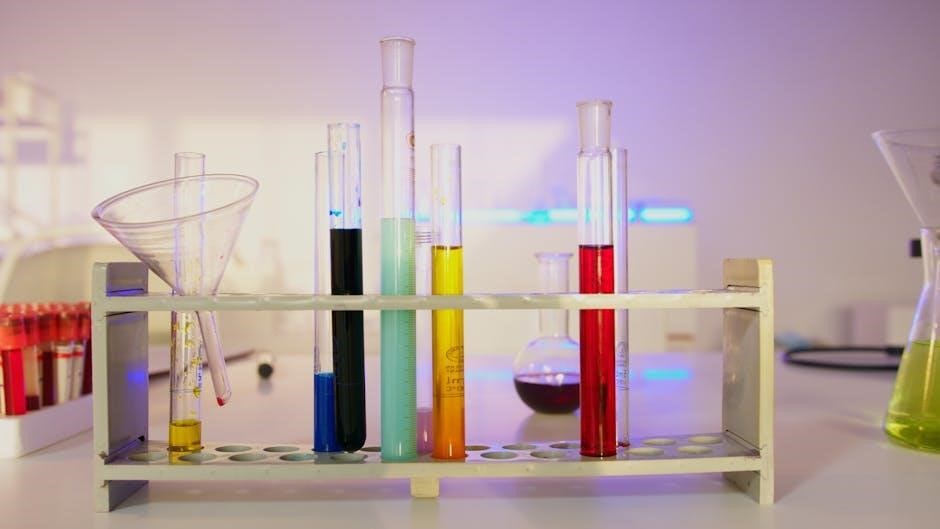
Waste Disposal Protocols
Proper waste disposal is paramount in the organic chemistry laboratory, adhering to strict environmental and safety regulations. Segregation of waste into designated containers – halogenated solvents, non-halogenated solvents, aqueous waste, and solid waste – is crucial. Never pour chemicals down the drain unless explicitly authorized.
Halogenated waste must be kept separate from non-halogenated waste due to differing disposal methods. Aqueous waste requires pH neutralization before disposal, and solid waste should be categorized based on its chemical composition.
Containers must be clearly labeled with their contents and dates. Consult the laboratory’s specific waste disposal guidelines and your instructor for clarification. Ignoring these protocols can lead to environmental contamination and potential safety hazards. Responsible waste management is a fundamental aspect of ethical laboratory practice.